Cement and sand render (traditional render) is the classic two-coat mix of sand, cement and water trowelled onto walls and then painted. It's the cheapest render, costing around £35–£60 per m² in the UK, and is durable when done well — but it's rigid, prone to cracking and usually needs painting and repainting. It remains a common, budget rendering choice and the standard for traditional repairs.
It's the render most people picture: grey, trowelled-on, then painted. Cheap and proven, but increasingly replaced by self-coloured modern systems on whole-house jobs.
- The traditional, lowest-cost render: a site-mixed blend of sand, cement and water, applied in two coats.
- Almost always painted afterwards, with a repaint cycle every 5–10 years.
- Durable when mixed and applied well, but rigid — so more prone to cracking than modern systems.
- Typical UK cost £35–£60/m², the cheapest option, and the standard for like-for-like repairs.
- Low breathability, so not ideal for older solid walls (use lime there).
What is cement and sand render?
Cement and sand render — often just called "traditional render" or "sand and cement" — is the render most people picture: a grey mix of sand, cement and water, trowelled onto the wall in coats and then painted. It's been the workhorse of UK rendering for the best part of a century, and it's still widely used today, especially where budget is tight or a repair needs to match existing traditional render.
Unlike modern factory-blended systems, traditional render is usually mixed on site by the renderer, who controls the ratio of sand to cement (and often adds lime or a plasticiser for workability). That flexibility is a strength in skilled hands and a weakness in unskilled ones, because the quality of the mix directly affects how the render performs.
The defining characteristics are that it's cheap, rigid and not self-coloured. Because it isn't through-coloured, it nearly always needs painting with masonry paint, and that paint needs refreshing every several years. It's also relatively hard and inflexible, which makes it more prone to cracking than modern thin-coat renders. For a like-for-like repair or a budget job it makes sense; for a premium whole-house finish, many homeowners now prefer a self-coloured modern system.
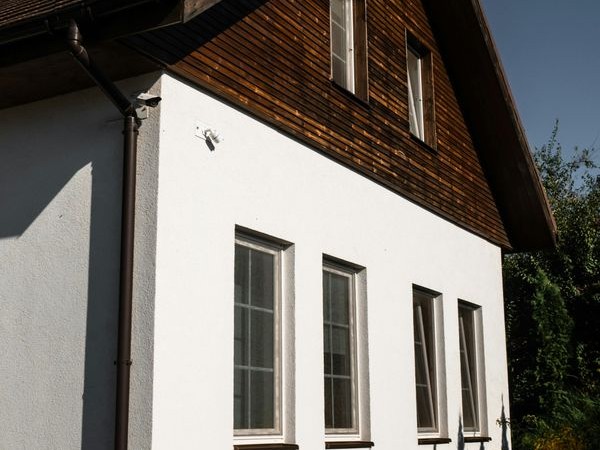
How cement and sand render works
Traditional render is built up in two coats:
- Scratch coat (base) — a stronger, sand-rich coat applied first and scratched with a comb to provide a key for the next coat.
- Top coat (float) — a slightly weaker, finer coat applied over the scratch coat and floated to a smooth or lightly textured finish.
- Painting — once fully cured, the render is sealed and painted with masonry paint, often two coats.
The "weaker on top of stronger" principle matters: the top coat should be no stronger than the base, so that any stresses are taken by the more robust layer beneath. Get the mix ratios wrong — too much cement, in particular — and the render becomes brittle and crack-prone. A skilled renderer also reinforces vulnerable points and may incorporate beads and movement allowances. Because it's a cement product, traditional render has relatively low breathability, which is why it's a poor match for older solid walls that need to release moisture.
How is cement and sand render applied?
- Preparation — scaffolding, cleaning, removal of any loose material, and fitting beads for clean edges.
- Scratch coat — applied and keyed, then left to cure for a day or more.
- Top coat — applied and floated to the desired finish.
- Curing and painting — the render is allowed to cure and dry thoroughly (this can take weeks) before being sealed and painted.
A key point homeowners often miss: traditional render must be fully dry before painting, which can mean a wait of several weeks. Painting too soon traps moisture and leads to peeling paint and blown render. As with all renders, it shouldn't be applied in frost or heavy rain, and fresh render needs protecting from fast drying to limit shrinkage cracks.
Benefits of cement and sand render
- Lowest cost — the cheapest render to supply and apply, ideal on a tight budget.
- Proven and familiar — a century of use and every renderer can work with it.
- Durable when done well — a correctly mixed and applied render lasts many years.
- Flexible finish options — can be smooth, textured, or finished with pebbledash or Tyrolean.
- Easy to repair like-for-like — the standard choice when matching existing traditional render.
- Repaintable in any colour — you can change the colour at each repaint, unlike self-coloured renders.
Need traditional render or a like-for-like repair? Get a free, no-obligation quote from one vetted local specialist.
Get a free quote →Drawbacks and things to consider
- Cracks more easily — its rigidity and the risk of a too-strong mix make cracking the most common complaint.
- Needs painting and repainting — not self-coloured, so expect a repaint every 5–10 years, adding lifetime cost and hassle.
- Low breathability — unsuitable for older solid walls; on those it traps damp and a lime render is correct.
- Quality depends on the mix — site-mixed render is only as good as the person mixing it.
- Longer drying time — must cure fully before painting, extending the project.
- Less modern look — painted render can look dated next to a crisp self-coloured finish.
How much does cement and sand render cost in the UK?
Traditional render is the cheapest option at around £35–£60 per square metre applied, though painting adds to that. Whole-property guides (render only):
| Property | Typical cost |
|---|---|
| Per m² (render) | £35–£60 |
| Per m² (incl. painting) | £50–£75 |
| Mid-terrace house | £4,000–£7,500 |
| 3-bed semi-detached | £5,000–£9,500 |
| Detached house | £9,000–£16,000+ |
Budget figures only, and remember painting (and repainting) is an ongoing cost a self-coloured render avoids. A survey gives the accurate number.
What affects the price?
- Whether painting is included — masonry paint and a second visit add cost.
- Preparation and removal — stripping old render or pebbledash.
- Scaffolding and access — height and elevations.
- Finish type — a plain float coat is cheaper than a textured or pebbledashed finish.
- Wall area and detailing — features and openings.
- Region — labour rates vary nationally.
Cement render vs modern render types
| Sand & Cement | Silicone | Monocouche | Lime | |
|---|---|---|---|---|
| Cost | Lowest | High | Medium | Highest |
| Needs painting | Yes | No | No | Optional |
| Crack resistance | Low | High | Medium | High |
| Breathable | Low | High | Medium | Very high |
| Maintenance | Repaint cycle | Minimal | Minimal | Refresh limewash |
| Best for | Budget/repair | Most homes | New builds | Period/listed |
Against silicone and monocouche, traditional render is cheaper upfront but loses on cracking, maintenance and that ongoing paint cycle — which is why self-coloured systems have largely taken over on whole-house jobs. On older solid walls, lime render is the correct breathable choice, not cement. Where traditional render still makes most sense is on a tight budget, or for a like-for-like repair that matches existing render.
Is cement and sand render right for your home?
- Budget projects — when keeping upfront cost down is the priority.
- Like-for-like repairs — matching existing traditional render on part of a wall.
- Walls you want to repaint in different colours — the flexibility to change colour at each repaint.
- Modern, stable masonry — where its low breathability isn't a problem.
It's the wrong choice for older solid-wall and listed buildings (use lime), and arguably false economy on a premium whole-house refurbishment, where a self-coloured silicone or monocouche finish avoids the repaint cycle and cracks less. A surveyor can weigh upfront versus lifetime cost for your situation.
Maintenance, cleaning and lifespan
Traditional render lasts 10–20 years or more when well applied, but the painted surface is the bigger maintenance item: expect to repaint every 5–10 years to keep it looking good and protecting the render. Watch for and fill cracks promptly before water gets behind the render and frost widens them. Walls can be cleaned with a soft brush and a gentle wash; avoid harsh jet washing, which can erode the surface and strip paint.
Common problems (and how to avoid them)
- Cracking — the classic issue, usually from too strong a mix, fast drying or a moving substrate. A correctly proportioned mix and proper curing prevent most of it.
- Blown or hollow render — where the render has debonded from the wall, often from poor prep or trapped moisture. Tapping reveals hollow areas.
- Peeling paint — from painting before the render fully dried, or using a non-breathable paint. Allow full curing and choose the right paint.
- Damp on old walls — using cement on a solid wall that needed lime traps moisture. The fix is the right render for the wall.
How to choose the right renderer
With site-mixed render, the renderer is the product — the mix ratios, the curing and the painting all come down to their skill. Look for someone who proportions mixes correctly (and isn't tempted to over-cement for a quick set), allows proper drying before painting, and can show you traditional render that's lasted. RenderSmart's SmartMatch™ weighs experience, verified reviews and reputation to pair you with the one best-fit local renderer, so a budget job is still a quality one.
Frequently asked questions
What is sand and cement render?
Is cement render cheaper than silicone?
Does sand and cement render need painting?
Why does cement render crack?
How long does cement render last?
Can I use cement render on an old house?
How much does it cost to render a house with sand and cement?
How long before you can paint new render?
Is cement render breathable?
Can cement render be repaired?
What's the difference between render and pebbledash?
Is cement render any good?
Can you render over old cement render?
Should I choose cement or monocouche render?
Do I need planning permission to render my house?
Does rendering need building regulations approval?
Get a free rendering quote
Tell us about your property and SmartMatch™ pairs you with one vetted local rendering specialist — for a free, no-obligation quote and survey.
Get a free quote →