Commercial rendering is the application of external render systems to commercial and multi-occupancy buildings — apartment blocks, offices, retail, industrial units, schools, healthcare and hospitality — rather than individual homes. The same family of rendering finishes is used (silicone, mineral, monocouche, acrylic and insulated render systems), but the specification is driven by scale, substrate, fire performance and certification rather than just looks. UK rates typically run from around £40–£90 per m² for the render itself, with access, insulation and preliminaries often adding as much again.
The defining difference from domestic work is compliance and coordination: fire classification, third-party certification, manufacturer-approved installers, system warranties and sequencing with the wider construction programme all matter as much as the finish.
- Covers new build and refurbishment across apartments, offices, retail, industrial, education, healthcare and hospitality.
- System choice is led by substrate (masonry, steel or timber frame) and fire performance, not just appearance.
- On taller and higher-risk buildings, non-combustible (A2-s1,d0 or A1) mineral systems are usually required.
- Valid system warranties (typically 15–25 years) generally depend on using a manufacturer-approved installer.
- Access (scaffold, mast climbers, MEWPs) and preliminaries are major cost and programme drivers at commercial scale.
What is commercial rendering?
Commercial rendering is the design, supply and application of external wall render systems on non-domestic and larger residential buildings. Technically the coatings are the same ones used on houses — thin-coat silicone, mineral and acrylic finishes, one-coat monocouche, and insulated render (external wall insulation) systems — but on a commercial project the render is treated as an engineered system rather than a decorative coating. It has to satisfy structural, thermal, weatherproofing and fire-safety requirements, carry the right certification, and be installed to a specification signed off by the design team and building control.
That shift in emphasis is the whole story. On a private home the conversation is mostly about colour, texture and price. On a commercial building it is about the substrate the system is fixed to, how the wall performs in a fire, what warranty the manufacturer will stand behind, and how the rendering programme dovetails with windows, roofing, M&E and handover. Get the specification right and render is one of the most cost-effective, versatile façade options available; get it wrong and it becomes a liability.
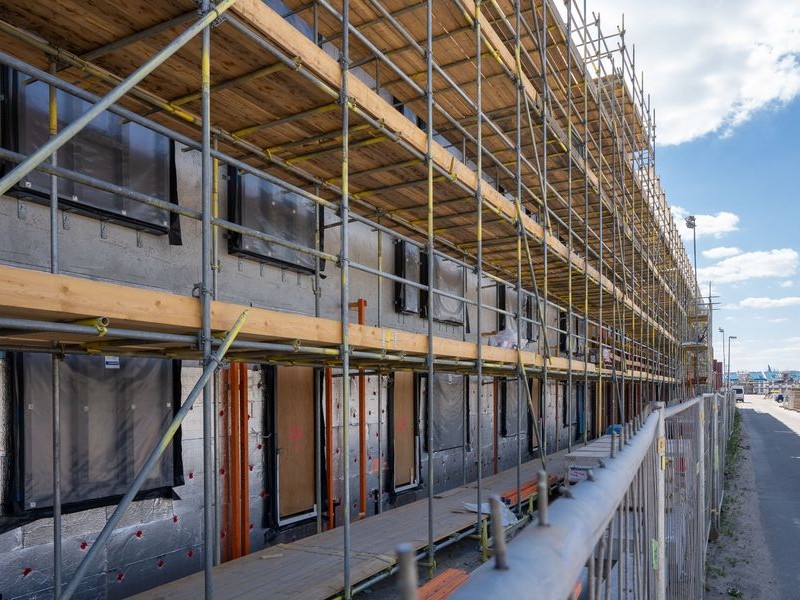
Types of commercial rendering project
"Commercial" covers a wide spread of building types, each with its own priorities. The systems overlap, but the drivers differ:
- Residential development & apartment blocks — new-build flats, student accommodation and build-to-rent. Fire performance and certification dominate, especially on taller blocks, alongside a clean architectural finish.
- Offices & mixed-use — render is often combined with brick, cladding and glazing as part of a designed elevation, so colour accuracy, crisp detailing and movement joints matter.
- Retail & leisure — fast programmes, phased handovers and a hard-wearing, easily maintained finish at ground-floor level where impact and graffiti are concerns.
- Industrial & warehouse — large plain elevations where economy per m² and durability outweigh decorative detail; render is sometimes used as infill alongside profiled cladding.
- Education & healthcare — schools, colleges and care settings where robustness, low maintenance, hygiene and strict compliance and procurement rules apply.
- Hospitality — hotels and venues where appearance and a premium, well-detailed finish carry commercial value.
- Refurbishment & overcladding — re-rendering tired buildings, remediating failed systems, or adding insulated render to upgrade thermal performance and appearance in one operation.
Got a commercial project in mind? Tell us the sector, scale and location and we'll match you with the right contractor.
Get a commercial quote →Render systems used on commercial buildings
Most commercial render falls into a handful of system types. The right one depends on the substrate, the building's fire requirements, the thermal target and the look the architect wants:
- Thin-coat silicone render — the contemporary default: water-repellent, breathable, through-coloured and low-maintenance over a mesh-reinforced base coat. Excellent looks, but the organic content means it is combustible, so its use is restricted on higher-risk buildings.
- Mineral render — a cement/mineral-based thin-coat finish that can achieve a non-combustible (A2-s1,d0 or A1) classification. This is the workhorse for taller and higher-risk buildings where fire performance is critical.
- Monocouche — a thick, one-coat through-coloured render, robust and well-suited to large masonry elevations.
- Acrylic render — extremely tough and impact-resistant, useful at ground-floor and high-traffic areas, but with low breathability and a combustible classification.
- Insulated render systems (external wall insulation / EWI) — insulation boards fixed to the wall and then rendered, upgrading thermal performance and appearance together. On taller buildings these must use non-combustible mineral wool insulation with a mineral finish.
- Render carrier-board systems — for steel frame (SFS) and timber-frame structures, render is applied to a cement-based sheathing or carrier board rather than masonry, as part of a tested, certified build-up.
- Specialist finishes — brick-effect renders, textured and through-coloured ranges, and decorative profiles where a particular architectural appearance is specified.
Fire safety and compliance
On commercial and multi-occupancy buildings, fire performance is the single most important specification decision, and it has tightened significantly in recent years. The external wall build-up must satisfy the Building Regulations (Approved Document B in England, with equivalents across the UK nations), and on relevant higher-risk buildings the materials in the external wall must be of limited combustibility — generally European fire classification A2-s1,d0 or A1.
What that means in practice:
- Building height and use set the rules. Above defined height thresholds (commonly cited around 11m and 18m, depending on building use and nation), combustible materials in the external wall are restricted or banned, so organic thin-coat (silicone/acrylic) renders and combustible insulation are ruled out.
- Non-combustible systems are the answer. Mineral renders over non-combustible mineral-wool insulation, fixed to masonry or a tested board build-up, are the usual route to compliance on taller blocks.
- Tested systems matter. Full systems can be assessed by large-scale testing (BS 8414) and classified to BR 135, or demonstrated as non-combustible by classification of every component. The system should be used exactly as tested and certified — substituting a single component can invalidate it.
- It is building-specific. The correct classification depends on the individual building, so fire strategy and specification should always be confirmed by the design team and building control, not assumed.
A credible commercial render contractor will be entirely comfortable with this language and will install only certified systems in line with the manufacturer's tested specification.
Need a contractor who works to a fire-compliant specification? We only match you with vetted, accredited firms.
Get a free quote →Specification, certification and warranties
Commercial render lives or dies on documentation. The finish on the wall is only worth what the paperwork behind it guarantees, so a properly specified project will involve:
- Third-party certification — system-level approval (such as a BBA Agrément certificate) confirming the build-up is fit for purpose and durable.
- Manufacturer-approved installation — most system houses only honour their warranty if the work is carried out by an approved, trained applicator, with site inspections during the works.
- System warranties — typically 15–25 years on a correctly installed certified system, covering the system as a whole rather than just the topcoat.
- Standards and accreditation — alignment with NHBC or warranty-provider requirements on housing, and relevant standards for framed and cladding build-ups.
- Design coordination — render details resolved with the architect and other trades: movement joints, beads and stop-ends, window and door interfaces, dpc and ground-level details, and penetrations for M&E.
Access, scaffolding and programme
At commercial scale, getting to the wall is often a bigger cost and programming challenge than the rendering itself. Render is also weather- and time-sensitive, which shapes the whole sequence:
- Access method — full scaffold, mast climbers, mobile elevating work platforms (MEWPs) or, occasionally, rope access. The choice affects cost, speed and how the elevation is sequenced.
- Drying and curing — each coat must cure before the next, and thin-coat systems should not be applied in frost, on frozen substrates, in heavy rain or in fierce direct sun. UK weather windows drive the programme.
- Phasing — large elevations are completed in planned bays to avoid visible day-joints, and the works are sequenced around window installation, roofing, and the wider trade programme.
- Protection and snagging — completed work is protected, and a formal snag and handover process is followed before sign-off.
How much does commercial rendering cost?
Commercial pricing is project-specific and quoted per scheme, but the render element generally falls into the ranges below. At scale the rate per m² for the coating itself can be keener than domestic work, but access and preliminaries frequently add as much again, and insulated systems sit well above plain render.
| System | Typical rate (per m²) | Notes |
|---|---|---|
| Thin-coat silicone | £40–£70 | Contemporary finish; combustible, so height-restricted |
| Mineral (non-combustible) | £45–£80 | Default for taller / higher-risk buildings |
| Monocouche | £45–£65 | One-coat, robust, large masonry elevations |
| Acrylic | £40–£65 | Impact-resistant; low breathability, combustible |
| Insulated render (EWI) | £90–£200 | Includes insulation; thermal upgrade + finish |
| Render carrier board (framed) | £70–£130 | Board build-up for SFS / timber frame |
Indicative supply-and-apply ranges for the render system only. Access (scaffold/mast climber), preliminaries, design, certification and VAT are additional and vary widely by site, height and complexity. Always price against a full specification.
Choosing a commercial render contractor
The gap between a good and a poor commercial render contractor is wide, and most of it is invisible until something fails. When you assess a firm, look for:
- Manufacturer approval for the specific systems being installed, so warranties are valid.
- Health & safety accreditation — CHAS, SMAS, SafeContractor, Constructionline or similar, plus trained, carded operatives and proper RAMS.
- Relevant insurance — public liability and professional indemnity at the level your project requires.
- Capacity and track record — comparable completed projects in your sector, with references and the resource to hold programme.
- Quality systems — ISO accreditation, documented inspections and a clear snag-and-handover process.
SmartMatch™ pairs you with one vetted commercial render contractor with the accreditations your project needs — not a directory of cold leads.
Get a free quote →The commercial rendering process
A well-run commercial render package follows a clear sequence from enquiry to handover:
- Survey & specification — substrate, height, fire requirements and finish are established and a compliant system specified.
- Design & approvals — details are coordinated with the design team and signed off, and the certified system and warranty confirmed.
- Access & protection — scaffold or alternative access is installed and adjacent areas protected.
- Substrate preparation — the wall or board build-up is prepared, beads and movement joints fitted.
- System application — insulation (where specified), base coat and mesh, primer, then the finish, applied in planned bays.
- Snag & handover — inspection, snagging, documentation and warranty issue.
Treated as an engineered system and installed by the right contractor, commercial render delivers a durable, certified, attractive façade — which is why it remains one of the most widely specified external finishes on UK buildings.
Frequently asked questions
What counts as commercial rendering?
What is the best render system for a commercial building?
Does commercial render need to be fire-rated?
Can silicone or acrylic render be used on high-rise buildings?
What warranty comes with a commercial render system?
Can you render a steel-frame or timber-frame building?
How much does commercial rendering cost per m²?
How long does a commercial render project take?
Can render be applied in winter?
Can you render over an existing or failed commercial system?
Do commercial render contractors work with main contractors?
What accreditations should a commercial render contractor have?
Is external wall insulation part of commercial rendering?
Does commercial rendering need planning permission?
Get a commercial rendering quote
Tell us about your project — sector, scale and location — and SmartMatch™ pairs you with a vetted commercial render contractor with the right accreditations for the job.
Get a free quote →