Pebbledash removal is the process of stripping the dated stony finish from a property and re-rendering it with a smooth, modern finish. It's labour-intensive and messy, so removal plus re-rendering typically costs £100–£170 per m² all-in. The usual replacement is a self-coloured silicone render. It's one of the most transformative rendering projects for kerb appeal.
The big decision isn't really "how to remove it" but "remove it or render over it?" — and that comes down to the condition of the existing pebbledash.
- Stripping the dated stony finish and re-rendering with a smooth, modern, usually self-coloured finish.
- The key decision: remove it, or render over it if it's sound and well-bonded — condition decides.
- Labour-intensive and messy; removal plus re-render typically £100–£170/m² all-in.
- Silicone render is the most popular replacement for a low-maintenance modern look.
- One of the highest-impact upgrades for kerb appeal and a dated property's value.
What is pebbledash removal?
Pebbledash (or "roughcast") is the textured finish — small stones or pebbles thrown onto a wet render base — that covers millions of UK homes, especially those built or refinished from the 1920s through the 1970s. It was practical and hard-wearing in its day, but to many modern eyes it looks dated, and it's notoriously difficult to clean, repair and keep looking smart.
Pebbledash removal is the process of stripping that finish off and replacing it with a smooth, contemporary render — typically a self-coloured silicone render that needs no painting. It's one of the single most transformative things you can do to a tired property's appearance, often making a 1960s semi look like a new build.
The crucial early decision, though, isn't how to remove it — it's whether to remove it at all. If the pebbledash is sound and well-bonded to the wall, it's sometimes possible to render straight over it, saving the considerable cost and mess of removal. If it's loose, blown, cracked or hollow, it has to come off. That judgement, made properly on a site survey, shapes the whole project and its cost.
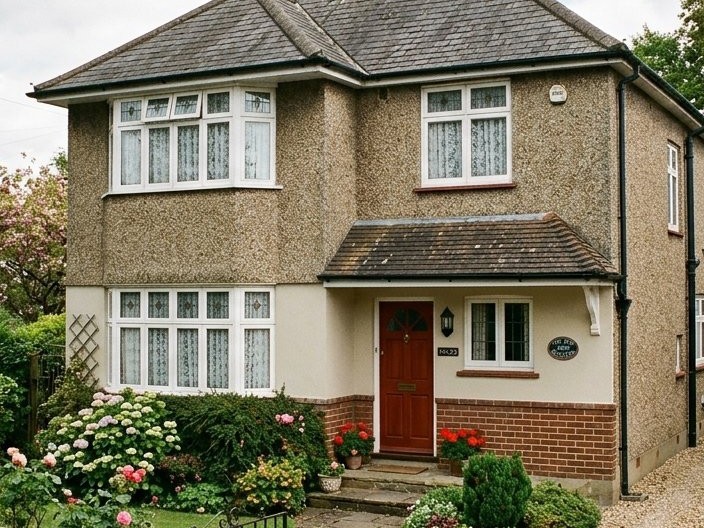
Remove it, or render over it?
This is the question every homeowner with pebbledash faces, and the honest answer is "it depends on the condition":
- Render over it — if the pebbledash is firmly bonded, sound and not blown, a base coat with mesh can often be applied straight over it, then a modern topcoat. This is cheaper, faster and far less messy.
- Remove it — if it's loose, hollow, cracked or debonding (tapping reveals hollow areas), rendering over it would just trap a failing layer, so it must be hacked off back to sound masonry first.
A good specialist tap-tests the existing finish across the property to map sound and unsound areas before advising. Sometimes the answer is mixed — remove the failed sections and overlay the sound ones. Beware anyone who insists on full removal (or full overlay) without checking; the right approach is dictated by the wall, not by habit.
How is pebbledash removed?
- Survey and decision — tap-testing to decide remove vs overlay, and checking the masonry beneath.
- Protection and access — scaffolding, and sheeting to contain the considerable mess and dust.
- Mechanical removal — the pebbledash is hacked off, usually with power tools, back to sound brick or block. This is hard, dusty, labour-intensive work.
- Making good — the exposed wall is repaired and prepared as a sound substrate.
- Re-rendering — a modern render system (commonly silicone) is applied for a smooth, self-coloured finish.
Removal is the messy, expensive part — there's a lot of debris, dust and labour involved, and the wall underneath sometimes needs repair once exposed. That's exactly why rendering over sound pebbledash, when it's possible, saves so much. As with all rendering, the finish can't be applied in frost or heavy rain.
Benefits of removing/re-rendering pebbledash
- Dramatic kerb-appeal boost — arguably the biggest visual upgrade available to a dated property.
- Modern, smooth finish — replaces a tired stony look with a clean contemporary surface.
- Self-coloured, low-maintenance — a silicone replacement needs no painting and resists dirt.
- Easier to clean — smooth render sheds dirt far better than stone-studded pebbledash.
- Chance to fix hidden problems — removal exposes the wall, so any masonry or damp issues can be put right.
- Better weather protection — a modern water-repellent finish outperforms old, cracked pebbledash.
- Can add value — a transformed façade often improves saleability.
Want to lose the pebbledash for a modern finish? Get a free, no-obligation quote from one vetted specialist.
Get a free quote →Things to consider
- It's messy and disruptive — removal generates a lot of dust and debris; good containment matters.
- Cost of removal — the stripping itself is labour-intensive, which is why overlaying sound pebbledash is so much cheaper.
- Hidden wall condition — you don't fully know the masonry's state until the pebbledash is off; budget some contingency.
- Old solid walls need breathability — on a period property, the replacement should be breathable (silicone or, for heritage, lime), not a trapping finish.
- Choose the right replacement — match the new render to the wall and your goals (see below).
How much does pebbledash removal cost in the UK?
Removal plus re-rendering typically costs £100–£170 per square metre all-in — more than a straightforward re-render because of the labour-heavy removal. Rendering over sound pebbledash costs less. Whole-property guides (removal + silicone re-render):
| Property | Typical cost |
|---|---|
| Per m² (remove + re-render) | £100–£170 |
| Per m² (render over, if sound) | £65–£95 |
| Mid-terrace house | £8,500–£14,500 |
| 3-bed semi-detached | £10,000–£18,500 |
| Detached house | £17,000–£28,000+ |
Budget figures only. Whether the pebbledash needs full removal is the biggest variable — a survey and tap-test give the accurate number.
What affects the price?
- Remove vs overlay — the single biggest factor; full removal is far more labour.
- Condition of the wall beneath — repairs once the pebbledash is off.
- The replacement render — silicone costs more than basic finishes but needs no painting.
- Access and scaffolding — height and elevations.
- Waste disposal — removed pebbledash is heavy and bulky to skip.
- Region — labour rates vary nationally.
What should you render pebbledash with?
Once the pebbledash is off (or overlaid), the replacement finish matters:
| Replacement | Why choose it |
|---|---|
| Silicone render | Most popular — self-coloured, breathable, water-repellent, low-maintenance. |
| Monocouche | One-coat, self-coloured, good value on sound walls. |
| Acrylic | Tough and economical, but less breathable — best on modern walls. |
| Lime | For period/solid-wall homes needing maximum breathability. |
For most homes, silicone render is the go-to replacement: it gives the clean modern look people want when they remove pebbledash, with no painting and excellent weather resistance. On a budget, monocouche or even painted sand & cement are options; on an older solid wall, choose a breathable system and consider lime.
Is pebbledash removal right for your home?
- Dated pebbledashed properties — where a modern smooth finish is the goal.
- Cracked or failing pebbledash — where the existing finish is past its best anyway.
- Homes being modernised or sold — for a major kerb-appeal lift.
If the pebbledash is sound and you mainly want a fresh look, rendering over it may achieve the same result for less. If it's failing, or you're addressing damp or masonry issues, full removal makes sense. A survey settles which path fits your property and budget.
Maintenance and lifespan after re-rendering
Once pebbledash is replaced with a modern silicone finish, maintenance drops dramatically: no painting, a largely self-cleaning surface, and a lifespan of 20–30 years. Gentle cleaning of any algae on shaded walls and keeping gutters and detailing sound is all that's usually needed — a world away from the dirt-trapping, hard-to-maintain pebbledash it replaced.
Common problems (and how to avoid them)
- Rendering over failing pebbledash — traps a debonding layer; avoided by proper tap-testing first.
- Underestimating the mess and cost — removal is heavy work; good containment and a realistic budget matter.
- Unexpected wall repairs — exposed masonry may need work; a contingency covers it.
- Wrong replacement on an old wall — a non-breathable finish on a solid wall causes damp; choose breathable render.
How to choose the right specialist
The most valuable thing a specialist brings to a pebbledash job is honest judgement on remove versus overlay — that decision drives the cost and the result. You want someone who tap-tests properly, advises straight, handles the messy removal cleanly, and re-renders with the right modern system for your wall. RenderSmart's SmartMatch™ weighs experience, verified reviews and reputation to pair you with the one best-fit local specialist for pebbledash removal and re-rendering.
Frequently asked questions
How much does it cost to remove pebbledash?
Should I remove pebbledash or render over it?
Can you render over pebbledash?
What can I replace pebbledash with?
Is removing pebbledash messy?
Does removing pebbledash add value?
Why is pebbledash so disliked now?
How long does it take to remove pebbledash and re-render?
Will removing pebbledash damage my walls?
Is silicone render the best thing to put on after removing pebbledash?
Can pebbledash be repaired instead of removed?
Do I need permission to remove pebbledash?
Is it cheaper to render over pebbledash than remove it?
What's underneath pebbledash?
Can you paint pebbledash instead of removing it?
Can I remove pebbledash myself?
Does rendering need building regulations approval?
Get a free pebbledash removal quote
Tell us about your property and SmartMatch™ pairs you with one vetted local specialist for pebbledash removal and re-rendering — for a free, no-obligation quote and survey.
Get a free quote →