K-Rend Polar White is a crisp, bright white — clean, modern and reflective, rather than a warm off-white. It suits contemporary homes and anything you want to look fresh and architectural, and it pairs well with anthracite or black windows, dark doors and slate-grey roofs. The trade-off is upkeep: being so pale, it shows surface algae and grime sooner than darker shades, so it rewards an occasional gentle clean. Like all K-Rend it’s through-coloured, doesn’t need routine painting, and is effectively permanent until you re-render, so sample it on your own wall first.
- Polar White is a crisp, bright white rather than a warm off-white such as Champagne.
- It suits contemporary homes and pairs strikingly with anthracite or black windows and dark roofs.
- On period, rural or warm-toned houses it can look stark; a softer off-white may sit better.
- Bright white reads differently in sun and shade, so sample it large, on the actual wall.
- Being very pale, it shows algae and grime sooner and rewards an occasional gentle clean.
- It’s through-coloured: no painting, but changing colour later means re-rendering.
What Polar White looks like
Polar White is a crisp, bright white — a clean white rather than a softened off-white or cream. On a wall it reads fresh, modern and architectural, reflecting daylight and giving a home the sharp face people associate with contemporary new builds and smart renovations. It’s the shade to look at when you want white to genuinely read as white.
That brightness is its whole appeal: it makes a house look immaculate and can transform a tired exterior. It’s also what makes it demanding. A bright white has nowhere to hide — uneven lines, poor detailing and weathering all show more clearly than on a mid-tone — so the shade rewards a careful installer and a well-designed elevation more than most.
How Polar White compares with other K-Rend whites and greys
K-Rend’s palette includes several whites and off-whites, and the differences between them are subtle on a chip but obvious on a house. Against a warm off-white such as K-Rend Champagne, Polar White is the crisper of the two; Champagne is softer and more forgiving, with a gentle warmth that Polar White doesn’t have. Against the greys, Polar White is the bolder, brighter statement, while a mid grey is calmer and hides everyday marks far better. Our K-Rend colours guide sets out the wider white, cream and grey families if you want to widen the shortlist.
The homes and styles it suits
Polar White is at its best on contemporary and modern homes: clean-lined new builds, flat-roofed or boxy extensions, and renovations going for a sharp, current look. It works particularly well where the architecture has strong, simple shapes — large expanses of glazing, crisp corners, a clear roofline — because the white throws those shapes into relief.
It also suits post-war houses being given a fresh modern face, and streets where neighbouring rendered homes already share a clean white palette. On a modern semi, for example, a Polar White body with anthracite windows and a dark front door gives a very different, much sharper result than the same house in cream. For more on how whites work across different house types, see our guide to white render houses.

Where Polar White can look stark
The brightness that flatters a modern box can feel cold on a cottage. On traditional, rural or period-style homes, a crisp white can look clinical against old stone, warm brick and timber, where a softer off-white or cream often sits more comfortably. It can also look abrupt in a terrace of warmer-toned houses, where it reads as the one house that doesn’t belong.
Retained brickwork is the other thing to look at hard. A strong orange or red brick plinth, chimney or neighbouring wall next to a stark white can produce a harsh contrast; some homeowners love that, others find it jarring once it’s at full scale. None of this rules Polar White out — it simply means the decision depends on the house and its setting, not on how good the colour looked on someone else’s new build.
How Polar White behaves in UK light
The same white can look like two different colours on two walls of the same house. On a south-facing elevation in bright sun, Polar White reads at its brightest and can be dazzling at midday. On a north-facing or shaded wall it reads cooler and greyer, sometimes with a slightly blue cast under a flat, overcast sky. In the low light of a winter afternoon, it can look softer still.
Texture plays a part too. A scraped finish and a dry-dash finish scatter light differently, so the same colour can appear subtly different depending on the finish you choose. None of this is a fault in the render; it’s how any bright white behaves. It does mean the white you see on a sunny sample is not necessarily the white you’ll live with on your shaded side elevation.
How to sample Polar White properly
Because the colour is permanent, sampling is your one real chance to be sure. A small chip under showroom lighting tells you very little about a bright white. Instead:
- Go large. Ask for the biggest sample board available, or a test area on the wall itself.
- Use the real elevations. Look at it on the front and on your most shaded wall, not just the sunny one.
- Watch it through a day. Check it in bright sun, flat cloud and evening light over several days.
- Hold it against your fixed elements. The roof, window frames, any retained brick or stone, and the house next door.
- Compare it with a neighbour. Put it side by side with a warmer white so you can see what you’re choosing between.
- See it at full scale. Ask your installer whether there’s a finished Polar White job nearby you can look at.
Once you’ve decided, make sure the exact colour name is written into the specification and quote.
What Polar White pairs with
Much of Polar White’s appeal is how strikingly it contrasts with darker details. It pairs especially well with anthracite or charcoal window frames, fascias and rainwater goods for the white-and-grey modern look, and with black ironmongery and dark front and garage doors. A deep blue or green door against a crisp white wall is a simple, effective way to add personality without changing the render.
As a bright, neutral backdrop it also works well with timber cladding and planting, letting warmer materials stand out. Be a little more careful with white window frames: two different whites side by side can make one look slightly off, so hold a sample against the frame before deciding. And, as with any scheme, the most successful results come from choosing render, windows and door together rather than one at a time.
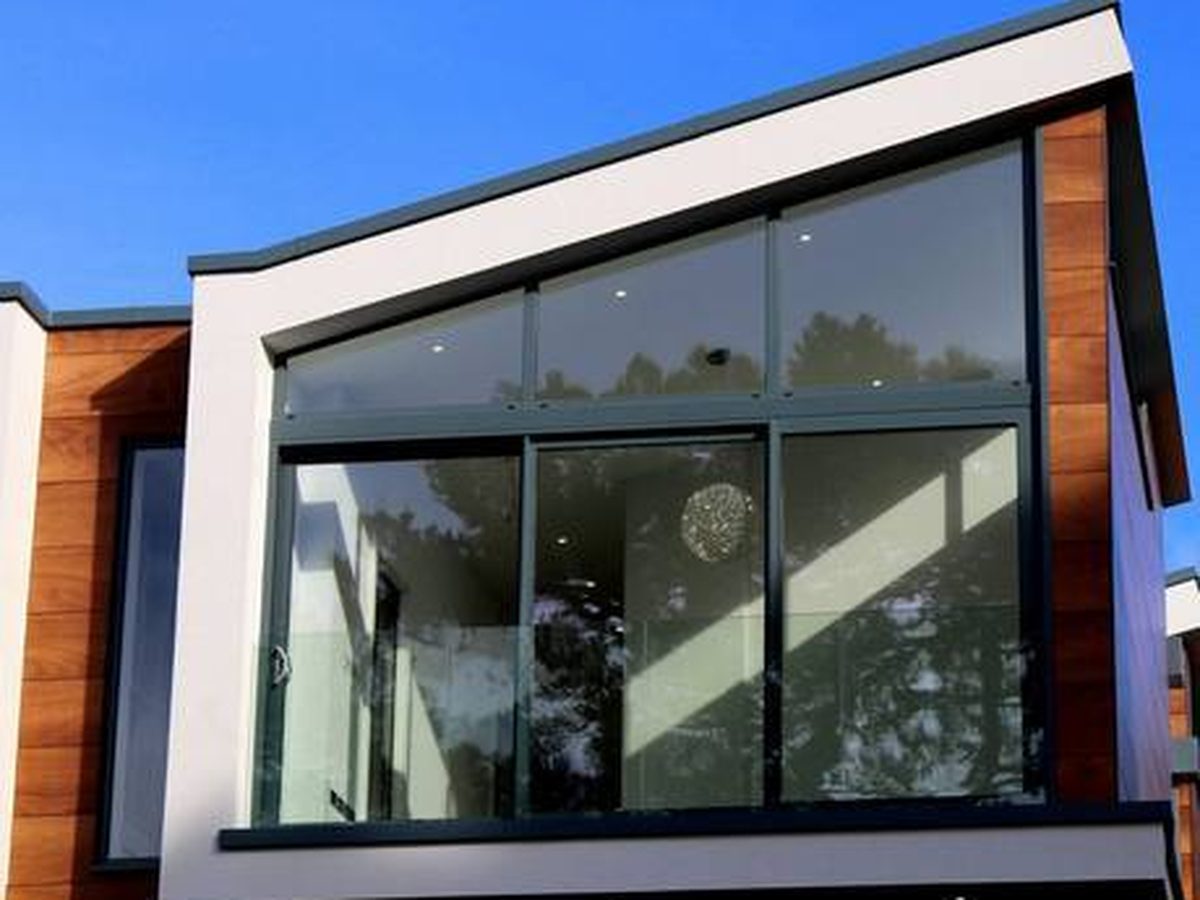
Working with your roof and fixed elements
The roof is the largest fixed element on most elevations and it sets the overall temperature of the house. A cool slate-grey or dark roof flatters Polar White and reinforces its crisp, modern character. A warm red or brown tile can work, but the contrast is more pronounced and the overall effect warmer and more traditional; this is where a softer off-white is sometimes the better partner.
Look too at the things you’re not changing: stone or concrete sills, a brick plinth, a porch, boundary walls and the neighbours on either side. A bright white throws every one of them into sharper relief, which can look deliberate and smart or simply unfinished. If the fixed elements are mismatched, sometimes the right answer is to plan small changes to them alongside the render.
Using Polar White in a two-tone scheme
Polar White doesn’t have to cover the whole house. It is a natural partner for a grey in a two-tone scheme — a white body with a darker grey feature gable, entrance recess or ground-floor band, or the reverse, with white used to lift detailing against a grey main wall. Our guide to K-Rend grey covers the grey side of that pairing.
Because each colour is through-coloured and applied separately, a two-colour scheme needs to be in the specification from the start, with the break lines agreed before work begins. Ask your installer to show you where those lines will fall against the building’s features: a change of colour that lines up with a natural break, such as a corner, a bead or a projecting bay, looks intentional; one that cuts across a flat wall rarely does.
Scraped or dry-dash: choosing the finish for Polar White
K-Rend is commonly finished either scraped or dashed, and other finishes exist in some ranges. The scraped texture — fine, even and slightly stippled — suits Polar White’s crisp, modern character well. The dry-dash finish, with stone aggregate thrown into the surface, gives a coarser, more traditional texture; it’s tougher and hides minor imperfections, but it’s harder to clean.
That cleaning point matters more on a bright white than on a mid-tone. A rougher surface gives dirt and algae more places to settle, and on white they show sooner. If low upkeep matters to you, a scraped finish is usually the easier one to keep looking crisp. Our guide to textured vs smooth render goes into the wider trade-offs.
Where Polar White stays brightest
Surface algae needs damp and shade to grow, so a bright white stays bright longest on walls that get sun and dry quickly. Sunny, open, well-drained elevations are the natural home for Polar White. Walls that are shaded by trees or neighbouring buildings, face north, or sit near damp vegetation tend to green up sooner — and on white, that shows first.
This doesn’t mean you can’t use it on a shaded house; it means you should go in with realistic expectations. A detached house in an open, sunny plot will hold its brightness far longer between cleans than a terraced house on a narrow, tree-lined street. If several of your walls are heavily shaded, it’s worth sampling a warmer off-white or mid grey alongside Polar White before you commit.
On any elevation, an occasional gentle, render-safe biocidal soft wash keeps Polar White crisp; a pressure washer is the wrong tool, because it can damage the textured finish and drive water into the wall. Our guide on how to clean K-Rend covers the method, and our guide to K-Rend white looks at keeping any white K-Rend bright over the long term.
Detailing that helps a white wall stay clean
Much of the grubbiness on a white wall comes from water running where it shouldn’t. Ask your installer how they’ll handle the details that control it: sills that project and shed water clear of the wall rather than letting it run down the face, gutters and downpipes in good order before the render goes on, and sound flashings where roofs meet walls.
The bottom of the wall matters too. Rain splashing up from hard paving can mark the lowest band of a white wall quickly, so ask how the base of the render will be finished and how close it will run to the ground. These are small conversations at survey stage that make a visible difference to how a Polar White wall looks a few winters later.
Considering Polar White? Get a free survey and written quote from one vetted local render specialist who can help you sample it on your own walls.
Get a free quote →Remember: the colour is permanent
Polar White, like every K-Rend shade, is through-coloured: the pigment runs through the topcoat, so the colour is the finish rather than a layer of paint on top. That’s the benefit — it doesn’t need routine repainting, there’s nothing to flake or peel. What looks like fading on a white wall is usually algae or grime, which cleans off.
The flip side is that you can’t simply change your mind later. Painting over through-coloured render throws away its main benefit and starts a repainting cycle; changing the colour properly means re-rendering. So treat Polar White as a decision you’ll live with for the life of the render, and give the sampling stage the time it deserves.
Does choosing Polar White change the cost?
Generally, no. A standard palette shade rarely changes the price or the lead time. What drives a K-Rend price is the wall’s condition, access and scaffolding, and how much detailing there is. As a guide, K-Rend is commonly around indicative £65–£95 per m² fitted, and rendering a single wall typically runs to around indicative £3,500–£5,000. Our K-Rend cost guide breaks the price down, and our house rendering cost guide compares it with other systems.
When Polar White might not be right for you
Polar White is a strong choice for the right house, but think twice if your walls are heavily shaded and you want the lowest possible upkeep; if your home is traditional or rural and the crisp white fights its brick, stone or roof; or if you live in a conservation area, where changing the colour or type of render can alter the external appearance and may need planning permission. Our guide to planning permission for rendering explains the rules; always confirm with your local planning authority.
There’s also a bigger question than colour. K-Rend itself is usually not the right system for older solid-wall or listed homes, which generally need a breathable lime render. If you’re unsure which camp your house falls into, our exterior rendering guide is a good starting point, and our K-Rend page explains where the system fits best.
Polar White on an extension or a single elevation
Not every project is a whole house. If you’re rendering a new extension or just the front elevation, think about how Polar White will sit against whatever else is staying. Next to existing brick, a crisp white extension can look like a deliberate contrast — often very effective on a modern rear addition. Next to older white or off-white render, it’s riskier: a brand-new bright white beside a wall that has weathered for years will rarely look like a match, and the difference tends to be most obvious exactly where the two meet.
If you’re matching existing render, take a sample to that wall rather than assuming any ‘white’ will do, and ask your installer where the junction will fall — a corner or a change in plane hides a difference far better than a joint in the middle of a flat wall. Sometimes the honest advice is that rendering the whole house at once gives a better result than trying to blend old and new.
Questions to ask your installer about Polar White
A short list of Polar White–specific questions at survey stage tells you a lot about how the job will be run:
- Which K-Rend range are you quoting, and is Polar White available in it in the finish I want?
- Can you provide a large sample, or a test patch on my wall, in that finish?
- How will you keep the colour consistent across every elevation, and where will each day’s work stop?
- How will sills, copings and the base of the wall be detailed so water doesn’t streak the white?
- Where will the colour or render meet any brick, timber or existing render that’s staying?
- What cleaning method do you recommend afterwards, and does anything affect the guarantee?
Write the answers down and check they appear in the quote. An installer who is vague about colour consistency or detailing on a bright white is telling you something useful before any money changes hands.
Getting Polar White applied well
A bright white is unforgiving of poor workmanship, so the installer matters even more than usual. Look for someone who will provide proper samples, write the exact colour into the specification, and plan the job so the colour is consistent across every wall — rendering the whole house in one go rather than one elevation at a time also means you only pay to put scaffolding up once. Ask to see a white job they finished a few years ago, and look at how clean the lines are around windows and corners.
Most of our specialists take on projects from around £3,500, so they’re best suited to larger repairs and re-renders; for a single small job, a local builder or plasterer may be quicker. If you’d like help finding the right person, SmartMatch™ introduces you to one vetted local render specialist for a free, no-obligation survey and written quote, so you can sample Polar White on your own walls before deciding.
Frequently asked questions
What is K-Rend Polar White?
How does Polar White compare with Champagne?
What does Polar White pair well with?
What homes suit Polar White?
Does Polar White get dirty quickly?
Is Polar White a good choice for a north-facing wall?
Should I choose a scraped or dry-dash finish in Polar White?
Does K-Rend Polar White need painting or fade?
How should I sample Polar White before choosing it?
Does Polar White cost more than other K-Rend colours?
Get a free K-Rend quote
Tell us about your property and SmartMatch™ pairs you with one vetted local render specialist who’ll help you sample colours on your own walls — for a free, no-obligation survey and written quote. No directory roulette, no pressure.
Get a free quote →