K-Rend grey means choosing from a band of through-coloured greys; grey render generally runs from pale silver and dove greys through versatile mid greys to deep anthracite, and the shades available depend on the K-Rend range you’re quoted. Grey is a popular choice on modern UK homes because it suits contemporary and updated traditional properties, pairs naturally with anthracite windows, and a mid grey hides everyday grime and early algae better than white. Mid and warm greys are generally the most forgiving to live with; the deepest shades run hotter in sun and show salts and water runs more readily. Like every K-Rend shade, grey is through-coloured, doesn’t need routine painting and is effectively permanent until you re-render, so sample it on your own wall first.
- Grey render runs from pale silver and dove greys, through versatile mid greys, to deep anthracite; ask which greys your quoted K-Rend range offers.
- The band (pale, mid or deep) sets the character; the undertone (warm or cool) decides whether it sits happily with your roof and brick.
- Mid and warm greys are generally more forgiving than pale or very deep shades: dark enough to hide grime and early algae, light enough to avoid the extra heat of the deepest shades.
- Very dark greys run hotter in sun and show salts, dust and water runs more readily; confirm the exact shade suits the system being used.
- Grey is through-coloured, so it doesn’t need routine painting, but the choice is effectively permanent until you re-render.
- Sample large, on the actual elevations, in sun and overcast light, and get the exact shade written into the specification.
The K-Rend grey range, from pale to anthracite
Grey isn’t one colour but a spectrum, and the greys available in the K-Rend palette depend on the range you’re quoted. At the light end sit pale silvers and dove greys, which read as soft, cool neutrals and keep a house feeling light. In the middle are the mid greys, in warmer and cooler versions, which give a smart, current look without being stark. At the dark end are the deep anthracites and charcoals, used for a bold, architectural statement, usually against lighter detailing or plenty of glazing.
Within each band there are named shades that vary in warmth and depth, and the exact names differ between ranges, so treat the bands as the useful decision rather than any single product name. Choosing the band first narrows the field before you ever handle a swatch: pale for gentle and airy, mid for smart and liveable, deep for confident and modern. Our K-Rend colours guide sets grey alongside the whites, creams and warmer tones in the wider palette.
Why so many homeowners choose grey
Grey’s popularity has practical roots. A well-chosen grey suits a crisp new build and an updated post-war semi alike, so it rarely looks out of place on a mixed street. It also sits naturally with the anthracite-grey window frames, fascias and rainwater goods now fitted on so many homes; the render and the joinery read as one deliberate scheme rather than two separate decisions.
The other reason is upkeep. A mid grey disguises road grime, splashback and the first faint film of algae far better than a bright white, so it looks clean for longer between washes. That combination of broad suitability and forgiving maintenance is why so many homeowners shortlist grey. The flip side is that a grey chosen purely because it’s popular can feel flat on the wrong house, which is why the rest of this guide is about matching the grey to the property rather than following the crowd.
Warm and cool undertones in grey render
Two greys of the same depth can look completely different on a wall because of their undertone. Cool greys lean slightly blue or green and read crisp, modern and a little steely. Warm greys carry a hint of beige, taupe or putty and read softer and more relaxed. On a small swatch the difference can be hard to see; across a whole elevation it becomes the thing you notice most.
The easiest way to spot an undertone is to hold the sample beside something neutral, such as a sheet of plain white paper or another grey, and see which way it pulls. Then hold it against your fixed materials. A cool grey beside a warm orange-red brick plinth can look cold and slightly at odds with it, while a warm grey sits more easily. A cool grey beside blue-grey slate or concrete tiles looks considered; a very warm grey can turn muddy against the same roof. Getting the undertone right does more for the finished look than agonising between two shades of similar depth.
Which grey suits which home
Pale and dove greys suit homes wanting a light, soft, understated look, and work on both modern and gently traditional properties; they behave more like white in how they show dirt. Mid greys are the all-rounders, smart and current on almost any house, and the lowest-risk choice if you’re unsure. Deep anthracites and charcoals suit contemporary homes with strong lines and generous glazing, especially where lighter detailing or timber can break up the mass.
Scale matters too. A deep grey across a large, plain two-storey elevation can feel heavy, while the same shade on a single-storey extension, a recessed entrance or a feature gable looks deliberate. A pale grey on a small cottage-style house can lift it; on a big detached box it can look washed out in flat winter light. Think about the size of the wall, how much glazing breaks it up and how close the house sits to the street before settling on a band. For the wider style question across every render type, see our guide to grey render houses.
Illustrative examples on typical UK homes
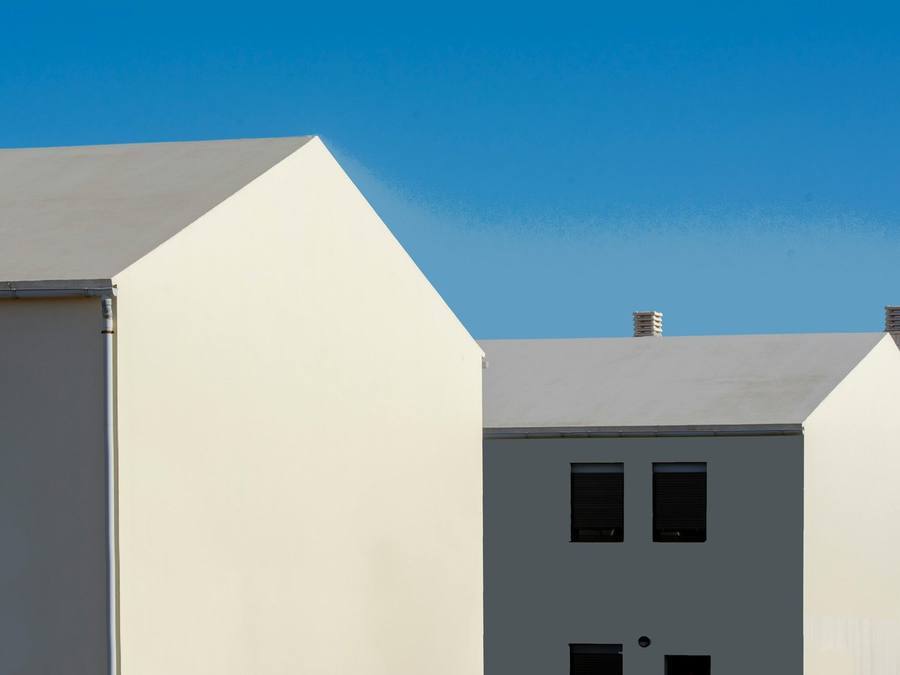
These are illustrative scenarios rather than case studies, but they show how the same thinking plays out on familiar property types.
A post-war semi with a red brick plinth and brown concrete roof tiles. The warm brick and roof pull against a cool steely grey, so a warm mid grey is usually the comfortable choice, with white or anthracite windows. Keeping the brick plinth exposed and the render above it gives a clean horizontal break.
A newer estate house with grey tiles and anthracite windows. Here a cool or neutral mid grey reads as a single, coordinated scheme. A pale grey also works if the house is shaded by neighbours and you want to keep it feeling light.
A modern detached house with large glazed openings. This is where a deep anthracite earns its place, often on the main mass with a lighter grey or white on a projecting bay or upper storey to stop it feeling heavy.
A rendered rear extension on a brick house. A mid or deep grey can make the extension read as a deliberate contemporary addition rather than an attempt to match the original, which rarely succeeds.
Pairing grey with windows, roof, doors and brick
The roof is the biggest fixed element and sets the temperature of the scheme. Slate and blue-grey tiles flatter cool and neutral greys; brown, red and terracotta tiles generally sit better with warmer greys. Windows come next: anthracite frames are the classic partner for mid and pale greys, while white frames against a deep grey give a sharper, more graphic contrast.
Doors, garage doors and rainwater goods are where you can add an accent. A deep blue, green or timber door against a mid grey adds warmth without fighting the render. Retained brick and stone deserve a close look before you commit, because a grey that looks perfect on its own can make a warm brick look orange, or a buff stone look dirty. Hold the sample against every material that will stay, outdoors, before deciding.
Using grey in a two-tone scheme
Grey is the colour most often used as one half of a two-tone render scheme: a grey body with white or pale detailing, or a pale main wall with a grey feature gable, band or recessed entrance. Because each colour is through-coloured and applied separately, the break lines need planning into the specification from the start, ideally falling at corners, beads, changes in plane or the line of a floor level rather than in the middle of a flat wall.
Keep the palette tight. Two shades from the same family usually look more considered than a hard contrast, and a scheme with three or four colours can make a modest house look busy. The popular grey-and-white pairing has its own guide, K-Rend Pewter Grey, which covers how that particular combination is laid out.
How the finish changes a grey
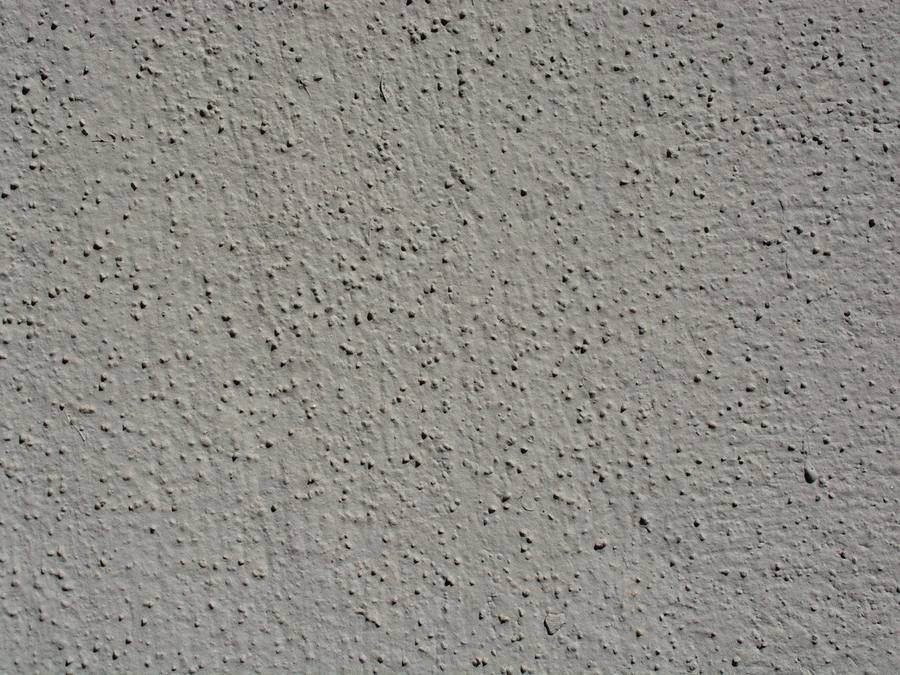
K-Rend is commonly finished either scraped or dry-dashed, and other finishes exist in some ranges; the finish changes how a grey reads. A scraped finish gives an even, fine texture, and the grey you see on the wall is close to the grey on the sample. A dry-dash finish has aggregate thrown into the surface; the stones and the small shadows between them alter the overall impression, often making the wall read a little darker and more mottled from a distance.
The finish also affects upkeep. Dry-dash has more surface area and sheltered pockets that hold moisture, so it tends to green up sooner and is harder to clean than a scraped finish. On a pale grey that difference shows quickly; on a mid grey it’s less obvious. If you like a textured look, our guide to K-Rend roughcast covers dry-dash in detail, and it’s worth asking to see a dash sample in your chosen grey rather than judging from a scraped swatch.
How light and aspect shift a grey
Grey shifts noticeably on a wall because it has no strong hue to anchor it. On a sunny south- or west-facing elevation a grey reads lighter and warmer; on a north-facing or shaded wall the same render reads cooler, darker and sometimes slightly blue. Under flat winter cloud, most greys lose contrast and can look heavier than you expected.
That’s why the sample you loved on a bright day can disappoint on the elevation that never sees the sun. If you’re torn between bands after all that, a mid grey is the lowest-risk middle ground. If your main street-facing wall faces north, judge the sample there, not on the sunny back wall. Some homeowners deliberately go a shade lighter than their first instinct on north-facing frontages to avoid a gloomy look, and a shade warmer if the house sits in heavy shade from trees or neighbours.
Shortlisted a few greys? SmartMatch™ pairs you with one vetted local render specialist for a free survey, written quote and samples on your own wall.
Get a free quote →How grey weathers and ages
A well-installed K-Rend system is commonly expected to last 20 to 30 years, and the through-colour holds well over that time. Grey is a forgiving colour to live with: everyday grime and the light film of algae that settles on shaded walls show far less starkly on a mid grey than on white, so a grey wall tends to look clean for longer with less attention.
Each end of the range behaves a little differently. Pale greys act much like white, showing green streaks under sills and on shaded elevations early. Deep greys hide algae well but reveal anything pale: dust, salts washing out of the wall, and run marks below sills and copings. Very deep, saturated shades can also show weathering more readily than mid-tones over the years. What looks like fading on any shade is usually dirt or growth rather than lost pigment, and a gentle clean brings the original grey back.
Dark greys: heat, movement and the specification
Anthracite and charcoal absorb far more of the sun’s heat than pale greys. The surface runs hotter and expands and contracts more as it heats and cools, which puts extra stress on the render system. That makes a sound substrate, a properly bedded mesh and a correctly cured base coat matter even more under a dark finish, and it makes the elevation the colour goes on part of the decision: a deep grey on a sheltered north wall is a different proposition from the same shade on an exposed south-west gable.
Manufacturers can place limits on very dark shades for certain build-ups, and those limits vary between systems, so there’s no universal rule to quote. Tell your installer early that you want a dark grey, say which elevations it’s going on, and ask them to confirm in writing that the exact shade is suitable for the specific system being used. On an insulated system that check is essential; our guide to external wall insulation render explains why.
Sampling grey on your own wall
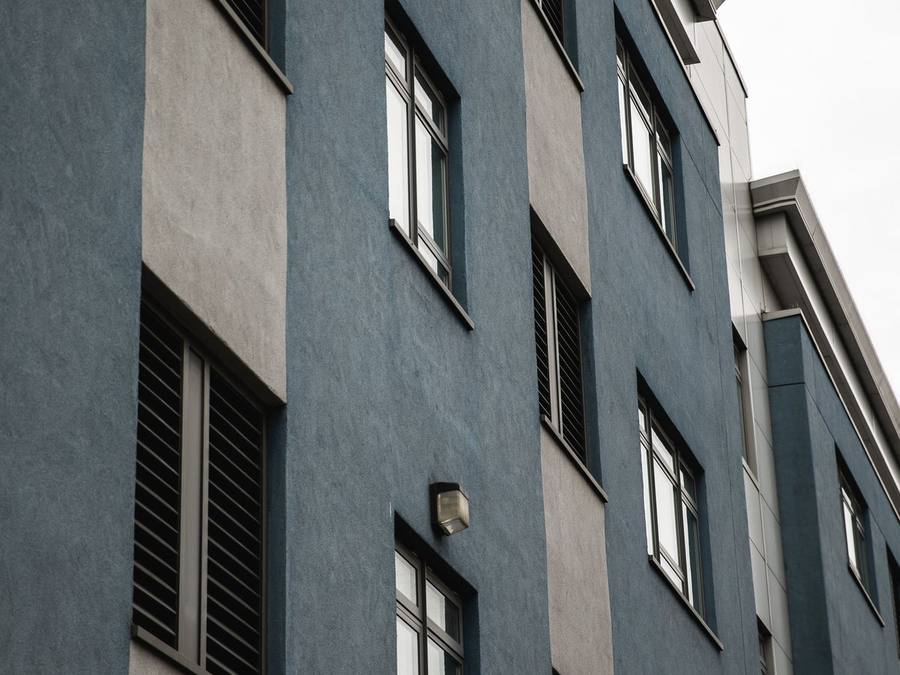
Grey is through-coloured, so the colour runs through the topcoat, doesn’t need routine repainting and can’t be casually changed later; to change it you’d re-render. That makes the sample stage your one real chance to get it right.
Ask for the largest samples available, or a test area applied to the wall, in your two or three shortlisted greys. Fix them side by side on the elevation that matters most and on the shadiest wall. Look in morning sun, flat midday cloud and evening light, and from the pavement as well as close up. Hold them against the roof, windows and any retained brick. Where you can, look at a finished house nearby in a similar grey at full scale. Once you’ve decided, make sure the exact shade name and finish are written into the quote and specification so there’s no ambiguity on the day.
Looking after a grey K-Rend wall
Upkeep for grey is the same as for any K-Rend shade, just less frequent than for white. Keep gutters and downpipes clear so water isn’t running down the face, keep vegetation off the wall, and keep soil and mulch below the base so splashback doesn’t mark the lower course. When a clean is due, the method is a gentle, render-safe biocidal soft wash, never a pressure washer, which can scar the textured finish; our guide on how to clean K-Rend walks through it.
On deep greys, the marks you’re most likely to notice are pale ones: water runs below sills, dust at ground level, or salts. Most are cosmetic and lift with a gentle clean, but persistent white marks in one area can point to water getting into the wall at that point, which is worth a specialist’s look rather than repeated cleaning.
Does choosing grey change the cost?
Generally, no. Picking a standard palette grey rarely changes the price or lead time compared with any other standard shade. As a guide, K-Rend is commonly around indicative £65–£95 per m² fitted. By number of walls, one elevation typically falls around indicative £3,500–£5,000, two walls around indicative £5,000–£8,000, three around indicative £8,000–£12,000, and four or more around indicative £12,000–£17,000+.
What moves the number is the wall rather than the grey: whether old render has to come off, access and scaffolding, the finish, and the amount of detailing around bays, sills and corners. A two-tone grey scheme adds a little labour for the extra break lines. Our K-Rend cost guide covers the brand-specific detail, and the wider house rendering cost guide compares every render type.
When grey K-Rend might not be right for you
Grey isn’t the answer for every house. On a period cottage or a home with lots of warm brick, stone and timber, even a warm grey can look imposed, and a cream or soft off-white often sits better. On a uniform street of white or cream render, a grey may look out of step, and in a Conservation Area, National Park, National Landscape or the Broads you need planning permission to render; our guide to planning permission for rendering covers the detail, and you should always check with your local planning authority. If you’re drawn to grey mainly because it’s fashionable, it’s worth living with a large sample for a week before deciding.
The bigger question is sometimes the render itself rather than the colour. Older, solid-wall and listed homes usually need a breathable lime render rather than a modern cement-based system, whatever the shade. And any wall with unresolved damp or movement needs that fixing first. Most of our specialists take on projects from around £3,500, so they’re best suited to larger repairs and re-renders; for a single small job, a local builder or plasterer may be quicker.
Briefing your installer on a grey finish
The finished result depends more on the installer and specification than on the shade card. Before you sign, make sure the quote states the exact grey and finish, the system being used, how the old surface will be prepared, and where any colour breaks will fall. If you want a deep grey, get written confirmation that the shade suits the system and the elevations. Ask to see completed grey jobs a few years old, not just fresh photos, so you can judge how they’ve weathered, and ask what cleaning method the installer recommends so you don’t unknowingly breach any guarantee.
For how a grey finish fits into the wider project, from surveys to scaffolding to curing weather, our guide to exterior rendering is the place to start. If you’d rather not vet installers yourself, our guide to finding a K-Rend approved installer explains what to look for, and SmartMatch™ can pair you with one vetted local specialist to survey the wall and help you sample greys in place. For an overview of the system itself, see our K-Rend page.
Frequently asked questions
What grey shades does K-Rend offer?
Why is grey such a popular render colour?
Should I choose a warm or a cool grey?
Which grey is best for my home?
How does grey K-Rend weather over time?
Are anthracite and charcoal renders a problem?
Does a dry-dash finish change how grey looks?
Does grey K-Rend cost more than other colours?
Do I need planning permission to render my house grey?
Can I change the colour of grey K-Rend later?
Get a free K-Rend quote
Tell us about your property and SmartMatch™ pairs you with one vetted local render specialist who’ll help you sample greys on your wall — for a free, no-obligation quote and survey. No directory roulette, no pressure.
Get a free quote →