A grey render house looks best when the depth and undertone of the grey are chosen to suit the roof, the windows and the light the walls actually get: pale greys for a soft, light look, mid greys as the forgiving all-rounder, and dark greys for modern statement walls on a system approved for them. Warm greys sit better with red brick and clay tiles; cool greys suit slate and anthracite frames. Mid greys disguise everyday dirt and early algae well, while very dark shades run hotter and can be restricted on some systems. Choosing grey rarely changes the price; the system, the area and the condition of the wall do.
- Decide the depth first — pale, mid or dark — then the undertone.
- Warm greys suit red brick and clay tiles; cool greys suit slate and anthracite frames.
- Mid greys hide road grime and algae well; dark greys show pale dust and salts.
- Dark greys run hotter, and some systems limit them — get the shade approved in writing.
- Judge samples on your own walls, on the dullest elevation as well as the front.
- In a conservation area or other protected area, a change to grey may need planning permission.
Why homeowners choose a grey render house
Most people who ask for grey are after one of three things. The first is a cleaner, more current look than the white or magnolia the house had before, without the stark brightness of a pure white. The second is a colour that will hide the dirt of a busy road, a damp garden or a shaded side passage for longer between cleans. The third is a way to tie the house to new anthracite windows, a slate roof or a contemporary extension.
Grey can do all three, but it is less of a neutral than it looks. A grey sits between black and white, so it takes on the character of whatever is around it: the colour of the sky, the roof, the brick next door and the frames. That is why one grey house looks crisp and architectural while a near-identical one down the road looks drab. The rest of this guide is about controlling those variables before the render goes on, because a through-coloured finish is hard to change once it has.
Pale, mid and dark greys on a whole house
The depth of grey sets the character of the house more than any named shade. Pale greys — silver, dove, putty — read almost as soft neutrals from the street. They suit smaller houses, bungalows and terraces where a dark wall would feel heavy, and give a lighter look than white with a little more forgiveness.
Mid greys are the safe middle: smart on a post-war detached, a refreshed semi or a new build, and dark enough to disguise weathering. Dark greys — slate, charcoal, anthracite — work best on crisp modern forms with large glazing, or as a single feature: a projecting bay, a gable, an extension or a stair core.
A grey on a small chip can look quite different across a whole elevation — often lighter and flatter in bright sun, heavier in shade. If you’re weighing a particular system, our K-Rend grey guide covers one manufacturer’s range.
Warm and cool undertones
Two greys that look identical on a chart can look like different colours on a house, because every grey leans somewhere. Cool greys carry blue or green; they look crisp and architectural in sun but can turn chilly and slightly blue on a north-facing wall or under a heavy sky. Warm greys lean towards beige, taupe or “greige”; they feel softer, look friendlier in flat light and tend to age more gently.
A quick test: hold your sample against a sheet of pure white paper. The undertone shows immediately. On older houses, rural settings and streets of brick, a warm grey usually sits more comfortably. On a contemporary build with lots of glass and steel, a cool grey reads sharper.
For a two-tone scheme, keep both greys in the same undertone family — a pale warm grey with a deep warm grey looks deliberate; a warm body with a cold blue-grey bay looks like two different jobs.
How grey reads in British light and on each elevation
British daylight is often soft, overcast and slightly blue, and grey is strongly affected by it. Under a heavy sky a mid grey can drop a full step darker than it looked at the merchant’s counter, and a cool grey can look almost blue. In low, warm evening sun the same wall can turn silvery or faintly beige.
North-facing walls get little or no direct sun for much of the year, so they show a grey at its coolest and darkest. If the front of the house faces north, choose a shade one step lighter or one step warmer than you’d pick for a sunny wall. South- and west-facing walls catch strong light that can wash a pale grey out to something close to off-white, and they take the most heat, which matters for the darkest shades. East-facing walls look bright and cool in the morning and flat for the rest of the day.
Setting changes things too. Among trees and hedges, greens reflect onto the wall and a cool grey can pick up a faint green cast; in a coastal or open upland setting, the big sky makes greys read lighter and bluer.
Which houses suit a grey render
New builds and contemporary extensions. Clean lines, large openings and flush details are where grey is at its most convincing. A mid or dark grey on the extension with a paler grey or white on the main house is a common way to separate old from new without either fighting the other.
Post-war semis and detached houses. Plain elevations with standard window openings take a pale or mid grey well and often look markedly more current for it. Where the house has a brick ground floor or bay, a warm grey above it usually beats a cool one.
Bungalows. A low, wide house under a big roof can look heavy in a dark grey. Pale and pale-to-mid greys keep it light; a darker grey on a porch or a single gable can add definition without weighing the whole house down.
Terraces. Your house is one bay of a longer facade. A warm pale or mid grey usually reads as a refresh; a charcoal house in a row of creams reads as a statement, and not always a welcome one.
Period houses. Victorian villas with mouldings, stone-dressed houses and cottages rarely look their best in cool or dark grey; the detail disappears and the house can look stripped. If grey appeals, a very warm, pale stone-grey is the one to sample.
Two-tone grey schemes and feature walls
Grey lends itself well to two-tone schemes because the pale and dark ends of one family relate naturally. The schemes that work tend to follow the building’s own structure: a darker grey on a projecting bay, a recessed entrance, an upper storey that oversails, a gable end or an extension, with a paler grey or off-white on the main walls.
Where the change of colour happens matters as much as which colours you choose. A colour break should land on a corner, a change of plane or a bead, never in the middle of a flat wall, where it will look like a patch. Your renderer will need to plan the junction, usually with a bead or a crisp internal corner, and finish one colour before starting the next. Ask to see how they detail it.
Keep the contrast deliberate. A pale and a dark grey look designed; two mid greys that are nearly the same look like a mistake. And limit the number of colours: two greys plus window frames is usually plenty, especially if there is brick or timber in the mix as well.
Pairing grey with windows, roofs and brick
Anthracite windows. Anthracite frames pair naturally with grey render. Against a pale or mid grey they give crisp definition. Against a dark grey wall they can disappear, which suits a minimal look but loses detail on a traditional house — consider a lighter wall or contrasting reveals.
White uPVC. Works with pale and warm mid greys. Bright white frames on charcoal render can look stark, so test before committing.
Roofs. Blue-grey natural slate and grey concrete tiles suit cool and neutral greys. Red, brown or orange clay and concrete tiles want warm greys; a cool blue-grey under a red roof is a common mismatch.
Retained brick. A brick plinth, ground floor or quoins pull warmth into the scheme. Greige and warm mid greys bridge to red and buff brick; our guide to render colours for red brick goes further.
Doors, gutters and fascias. Black or anthracite rainwater goods disappear neatly against mid and dark greys. A front door in a strong colour — deep green, yellow, oxblood — is often what stops a grey house looking monochrome.
How the render system and texture change a grey
The same grey looks and behaves differently depending on what it is made from. Thin-coat silicone finishes are water-repellent, so rain runs off and the wall dries quickly; that helps any grey stay even, and it is why a silicone render is a common choice for mid and pale greys on exposed or shaded walls. Acrylic is through-coloured and flexible but less water-repellent, so it can hold more dirt on an urban elevation. Monocouche is a through-coloured, scraped finish; its slightly open surface holds more grime, and white lime bloom shows most clearly on darker shades.
Painted sand and cement is the one route where you can change your mind: repaint and the grey changes. The trade-off is that masonry paint dulls and needs renewing, and darker painted greys show it sooner. Our guide to through colour render compares the two approaches.
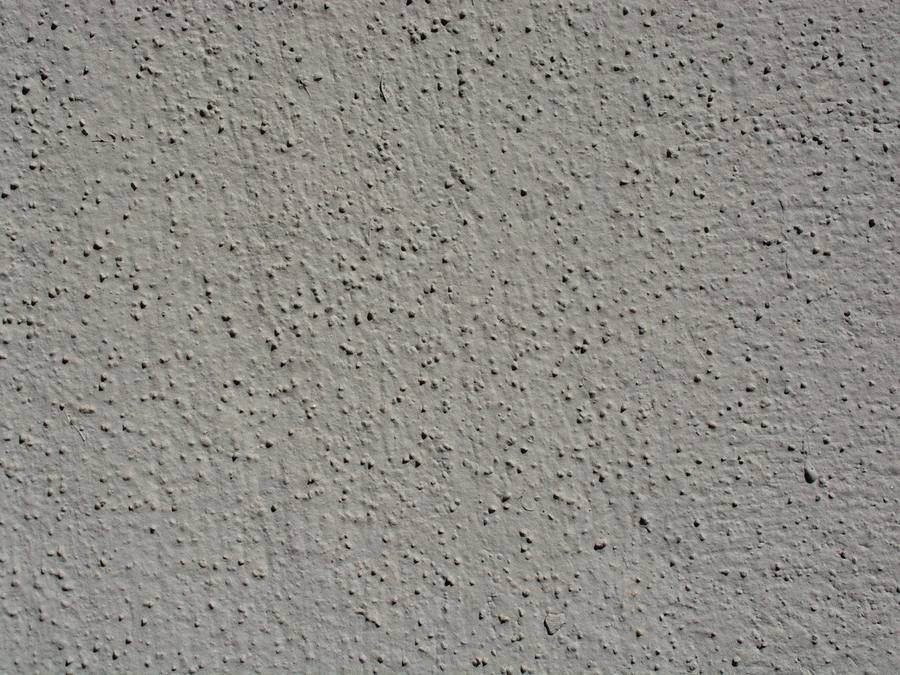
Texture shifts colour too. A fine, smooth finish shows the grey closest to the sample; a coarser grain or a dash catches shadow in every hollow and reads a touch darker and more varied.
How grey weathers and shows dirt
Grey is one of the most forgiving colour families on British walls, but not uniformly. Mid greys disguise road grime, splashback at ground level and the first green film of algae well, because there is little contrast between the dirt and the wall.
Pale greys behave more like white: green streaks below sills and on shaded north elevations show early. Dark greys hide green growth well but reveal anything pale — dust, salts washing out of the wall, and white run marks below copings and sills. Deep, saturated shades on sunny south and west elevations can also look slightly faded or chalky over the years; our guide to do render colours fade explains what’s fading and what’s just dirt.
If a shaded wall already goes green, read about algae on render before choosing a pale shade for it.
Planning a grey render house? SmartMatch™ pairs you with one vetted local render specialist for a free survey, written quote and samples in your shortlisted greys.
Get a free quote →Detailing that keeps a grey wall even
Most of the marks that spoil a grey wall are caused by water running where it shouldn’t, so detailing matters as much as shade. The points to check on any quote:
- Sills that project. A sill that sits flush with the new render lets water run straight down the face, leaving a pale or dark streak beneath every window. Sills should throw water clear of the wall.
- Drips at window heads and soffits. A drip bead or formed drip stops water tracking back under the head and down the reveal.
- Copings and cappings. Garden walls, parapets and chimneys without a proper overhang cause the vertical run marks that show so clearly on dark greys.
- A base bead clear of the ground. Render taken down into soil or paving wicks up moisture and gets splashed with mud. A clean line above ground, often with a gravel strip below, keeps the bottom of a grey wall from going darker than the rest.
- Gutters and downpipes in good order. One leaking joint will stain any colour, and on a mid grey it shows as a dark wet tide-mark.
Dark greys and heat limits
Charcoal and anthracite render absorbs far more of the sun’s heat than a pale grey. The surface runs hotter and moves more as it heats and cools, which puts extra stress on the system. That’s why some manufacturers set a minimum light reflectance value for certain build-ups, offer formulations intended for darker shades, or don’t allow the deepest colours over insulation boards at all. Our guide to render colours explains light reflectance value in more detail.
The limits differ between systems, so there’s no universal rule. Tell your renderer early that you want a dark grey, say which elevations it’s going on, and ask them to confirm in writing that the exact shade is approved for that system. On an insulated system this check is essential; our EWI render guide explains why.
If the shade you love isn’t approved for a big sunny wall, there are honest compromises: use it on a smaller or shaded elevation only, step one shade lighter, or keep the dark tone for frames, fascias and the front door against a mid-grey wall.
Testing grey samples on your own walls
A grey chosen from a screen or a fan deck is a guess. Before you sign off a through-coloured finish, get proper samples — ideally boards or panels in the real system and texture, not painted cards — and look at them on the house.
- Shortlist three. Usually one step lighter, your favourite, and one step darker or warmer.
- Look on at least two elevations. The front, and the dullest wall — usually the north or the shaded side.
- Look at different times. A bright morning, a grey afternoon and early evening. A grey that works only in sunshine will disappoint for much of the year.
- Look from the street. Step back to the pavement and across the road. Kerb appeal is judged at that distance, and the roof and neighbours come into view.
- Look against the fixed elements. Hold samples next to the window frames, the roof line, any brick and the house next door.
Then write the exact shade and system name on the quote. It sounds obvious, but a verbal “the mid grey we talked about” is how the wrong colour arrives on site.
Grey in conservation areas and on a uniform street
In England, re-rendering in a similar appearance is usually permitted development, but changing the colour can alter the external appearance and may need permission. In a conservation area, National Park, National Landscape or the Broads, rendering needs planning permission, and a switch from white or cream to charcoal is exactly the kind of change a council will look at. Article 4 directions, listed status and flats add further restrictions, and rules differ in Wales, Scotland and Northern Ireland. Check with your local planning authority first; our guide to planning permission for rendering explains how.
Outside protected areas, think about the row. On a matching pair of semis or a terrace, a mid or warm grey usually lifts the house without jarring; a near-black half of a pair can look unfinished from the street.
What a grey render house costs
Choosing grey rarely changes the price. Render is priced on the system, the wall area, the state of the existing surface and access. Many greys are standard shades; a dark shade that needs a particular formulation may affect price or lead time, so ask the question when you request samples.
As indicative supplied-and-applied guides, silicone typically runs around indicative £65–£95 per m², acrylic indicative £60–£90, monocouche indicative £55–£90, and sand and cement indicative £35–£60 before painting. Where pebbledash or failed render has to come off first, stripping and re-rendering is more like indicative £100–£170 per m². On an insulated system, expect indicative £90–£150 per m², excluding scaffolding and removal of old render.
By number of walls, one elevation typically comes to around indicative £3,500–£5,000, two walls £5,000–£8,000, three £8,000–£12,000, and four or more £12,000–£17,000+. Scaffolding and a two-tone colour break are worth seeing itemised. Our guide to house rendering cost breaks the figures down.
Cleaning and looking after a grey render house
Grey’s big advantage is that it asks for less attention than white, but it isn’t maintenance-free. A quick look round the house each spring and autumn will catch the things that cause marks: blocked gutters, a cracked sill, soil or bark heaped against the base of the wall, or a climbing plant getting a hold.
When a wall does need cleaning, the safe method is a render-safe biocide or cleaner applied at low pressure, left to work and then gently rinsed. Avoid pressure washing: it can damage the surface, open the texture and push water into the wall, and the roughened finish tends to mark again sooner.
Fine hairline cracks show less on grey than on white, which is no reason to ignore them. Have them looked at before water gets behind the render.
What to ask your renderer about a grey scheme
- Is this exact shade approved for this system, on these elevations? Will you confirm it in writing?
- Can I see samples in the real system and texture, large enough to judge on the wall?
- Have you done this grey, or a similar one, before? Do you have photos of it after a few winters?
- Where will a two-tone colour change fall, and how will you detail the junction?
- Are sills, drips, copings and the base bead included, and what changes are you proposing?
- Will the whole of each elevation be finished in one continuous session to avoid patchy colour?
- What aftercare do you recommend, and what does the manufacturer’s guidance say about cleaning?
When grey isn’t the right choice, and next steps
Grey isn’t automatically the modern answer. On a stone-built cottage, a Victorian villa with ornate mouldings or a street of warm creams, a soft white or stone shade will often look more at home; compare our guides to the white render house and the cream render house. For the wider palette, see our guide to render colours.
Colour also comes after the wall itself: cracked or hollow render, or a solid wall that needs a breathable system, has to be put right first. Our guide to exterior rendering covers the full picture.
SmartMatch™ weighs render-type experience, verified reviews, online reputation, insurance and accreditation to introduce you to one vetted local specialist for a free, no-obligation survey and written quote. Most of our specialists take on projects from around £3,500, so they’re best suited to larger repairs and re-renders; for a single small job, a local builder or plasterer may be quicker.
Frequently asked questions
What shade of grey render looks best on a house?
Should I choose a warm or cool grey render?
Does grey render go with anthracite windows?
Does grey render show dirt?
Is dark grey render a problem?
Do I need permission to render my house grey?
Will my grey look darker on the house than on the sample?
Does grey render cost more than white?
Can I use two shades of grey on one house?
Is grey a good colour for a bungalow?
See your grey on your own walls
Tell us about your property and SmartMatch™ pairs you with one vetted local render specialist for a free, no-obligation survey and written quote, with samples of your shortlisted greys.
Get a free quote →