A white render house looks bright, clean and timeless, suits everything from Regency villas to contemporary new builds, and reflects heat well, which keeps thermal movement low; the trade-off is that white shows rain streaks, splashback and green algae sooner than any other colour. A softened off-white reads as white from the street but is far more forgiving up close than brilliant white. Choose a water-repellent system such as silicone, insist on detailing that throws water clear of the wall — projecting sills with drips, a base bead above ground level, sound gutters — and expect a gentle biocidal clean every few years on shaded elevations. White costs no more than most other colours; the system and the size of the house drive the price.
- White shows dirt sooner because of contrast, not because it attracts more of it.
- A slightly warm or grey off-white reads as white from the street and hides far more.
- Water-repellent systems such as silicone stay whiter for longer than open-textured or painted finishes.
- Detailing — drips, sills, base beads, gutters — decides where streaks form.
- Shaded, north-facing walls under trees are where white struggles most.
- In a conservation area, rendering or changing to white usually needs planning permission — check first.
Why homeowners choose a white render house
White has a long history on British houses. Limewashed cottages in Cornwall and Pembrokeshire, stucco terraces in Brighton and Cheltenham, the sun-trap semis of the inter-war years and the crisp new builds of today all share it. It works because it makes a house read as one clean shape: windows, doors and roofline stand out sharply, and a muddle of old brick, block and repairs disappears under a single surface.
There are practical reasons too. White reflects more of the sun’s heat than any other colour, so the surface stays cooler and moves less, and it’s suitable on virtually every system, including over insulation boards, where some manufacturers restrict darker shades. White pigment is also extremely lightfast: a white wall doesn’t fade the way a deep red or charcoal can. What it does is get dirty, and how quickly that shows is the real question this guide is about.
If you’re still choosing between colour families, our guide to render colours compares them; this page is for anyone already leaning towards white.
Brilliant white vs off-white: which white?
“White” on a render chart covers a surprisingly wide range. At one end sits brilliant white: as pure and bright as the system allows, with a light reflectance value close to the top of the scale. At the other are off-whites with a small amount of another pigment in them, and that undertone matters more than the name.
Warm off-whites carry a trace of yellow or red. They look soft and settled, flatter red brick and clay tiles, and stop a white wall looking icy on a grey day. Lean too far and they drift towards cream; our guide to cream render house colours covers that territory.
Cool or grey off-whites carry a trace of black or blue. They look crisp and architectural next to anthracite windows and slate roofs, and they hide the faint grey film of traffic dirt better than brilliant white does.
A useful test: hold a sheet of printer paper against each sample outdoors. Brilliant white will match it; an off-white will suddenly look cream or grey beside it. Yet from the pavement, most off-whites still read simply as “white”.
How white reads in UK light
White has almost no colour of its own, so it borrows colour from whatever light falls on it, which makes it one of the most changeable render shades.
Under the flat, grey skies of a typical winter day, brilliant white picks up the sky’s blue-grey cast and can look cold, even slightly dingy, which surprises people who chose it from a sunny sample. In bright summer sun the same wall can be glaring, especially on a coastal site where light also bounces off water and sand. Low winter sun rakes across the surface and shows every ripple in the wall, which matters more on white than on darker shades because the shadows contrast so strongly.
Surroundings tint it too. A white wall facing a lawn or a bank of trees takes on a faint green tinge; one facing a red-brick neighbour picks up warmth. In northern towns with more overcast days, a warmer off-white often looks more comfortable year-round than brilliant white; on a bright south-coast seafront, brilliant white is at home.
White by aspect: north, south, east and west
North-facing walls get no direct sun for much of the year. White looks cooler and greyer here, and, more importantly, the wall stays damp longer after rain. That is where green algae appears first, and on a brilliant white it can show within a few years.
South-facing walls dry quickly and rarely go green, but they catch the most glare and show raking-light shadows across uneven walls. They’re also where a painted white will chalk and need renewing first.
West- and south-west-facing walls take most of the UK’s wind-driven rain. On a white house they’re where streaking beneath sills, copings and window heads shows most clearly.
You can’t sensibly use a different white on each elevation, so choose a shade that still looks right on your worst-lit wall. Test samples on the north side as well as the front, and judge them on a dull afternoon as well as a bright morning.

Why white shows dirt, algae and streaking
White render doesn’t attract more dirt or algae than grey or cream. Every exterior wall collects the same airborne spores, soot and dust. White simply shows it, because a faint film that would vanish on a mid grey stands out sharply against a bright surface.
Green algae grows where the wall stays damp and shaded: north walls, under trees, beside hedges, below leaking gutters. Our guide to algae on render explains the biology and treatment.
Dirt tracks are vertical grey streaks running down from the ends of sills, copings and window heads, where rainwater collects grime and leaves it as it dries.
Splashback is a muddy band along the base of the wall, from rain bouncing off soil, paving or gravel.
Traffic grime is a fine grey film, often heaviest on the elevation facing a busy road.
Rust and run-off appear as orange or brown streaks from old metal brackets, satellite dish fixings, unprotected steel and some flashings. Overflow and condensate pipes leave their own stain lines.
Several of these are about how water moves across the wall, not about the render at all. Our guide to render staining covers identifying and removing marks of every kind.
How the render system affects how white stays white
The same white looks very different after five winters depending on what it’s made from. This is the decision that most affects upkeep, more than the shade.
Silicone. Silicone resin makes the finish strongly water-repellent: rain beads and runs off, the surface dries fast, and dirt and spores have less chance to settle. Many silicone finishes also contain a biocide that slows algae for the first years. For a white house on an average UK site, a silicone render finish is usually the most practical choice.
Acrylic. Through-coloured and flexible, but less water-repellent than silicone, and the surface can soften slightly in summer heat and hold more dirt. White acrylic tends to grey sooner on exposed or urban elevations.
Monocouche. The scraped surface is slightly open, so it holds more grime than a thin-coat silicone and a white monocouche tends to dull sooner on damp or urban elevations.
Painted sand and cement. Cheapest to install, and you can restore the white at every redecoration, but the paint chalks and dulls, so you’re trading cleaning for repainting. Our guide to through colour render compares the two.
Lime and limewash. The traditional white of older buildings. Limewash weathers gently and evenly, slowly eroding rather than holding dirt, and is renewed rather than cleaned. It’s the right answer on many older, solid-walled houses.
Texture plays a smaller part: a finer finish gives dirt fewer ledges to sit on, while a coarse dash breaks up streaks but holds grime deeper and makes white read slightly creamier.
Detailing that throws water clear of a white wall
Most of the dirt on a white house arrives with water. Get the water off the wall quickly and cleanly and the white stays white. These are the details to discuss at the survey, before a quote is accepted.
Sills with a proper drip. A sill should project well clear of the finished render face, with a drip groove underneath, and ideally upturned ends so water doesn’t spill off the corners. Many old sills end flush once a new render is added; extending or replacing them is one of the most effective things you can do.
Drip or bellcast beads. A bead over window and door heads, and at the base of the render, makes water drip off rather than run down.
Copings and parapets. Wall tops need copings with drips on both sides. A flat-topped rendered wall is likely to streak within a season or two.
A base bead above ground. Render should stop above the damp-proof course and well clear of paving or soil. A gravel strip at the foot of the wall cuts splashback dramatically.
Gutters, downpipes and overflows. Leaking joints and blocked hoppers cause the worst algae on any white house. Fit downpipe stand-off brackets, and redirect condensate and overflow pipes so they don’t discharge down the render.
Fixings. Use stainless or coated brackets, and seal through-fixings so water can’t track in and rust can’t track out.
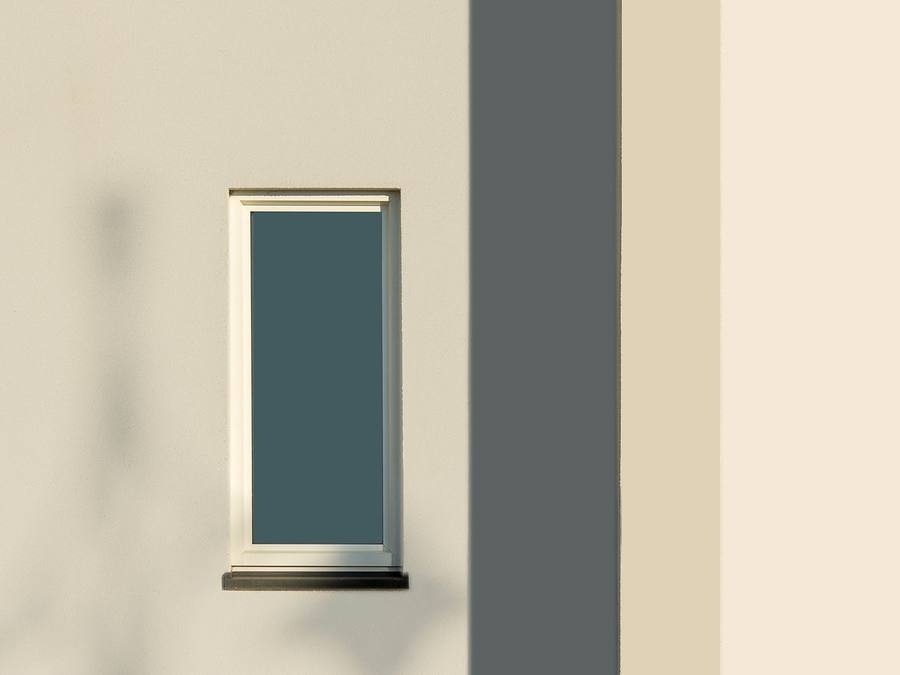
Cleaning a white render house
Even with good detailing, a white house on a damp UK site will need a clean sooner or later. The right method is the same whatever the system: a render-safe biocide applied at low pressure, left to work, then a gentle rinse or soft-brush. The biocide kills growth at the root, and residual dead algae often keeps weathering away for weeks afterwards, so the wall can look better a month after cleaning than on the day.
Never use a pressure washer. On white render the temptation is greatest because it clears green instantly, but it can strip the finish, open up the texture, drive water into the wall and void guarantees, and the roughened surface goes green again faster. Household bleach isn’t a substitute for a proper product either: it can mark some finishes and does little to stop regrowth.
How often depends on the wall. A sunny, well-detailed elevation may need nothing for many years; a shaded north wall beside trees may want a treatment every few years. Many owners clean only the problem elevation, which is perfectly sensible. For the shade-specific advice on one popular system, see our guide to K-Rend White.
How a white render ages
On a good through-coloured system, white doesn’t fade or yellow in any meaningful way. What changes is the surface: a fine film of dirt builds up, slowly at first and then more visibly on the wettest parts of the wall. A clean restores the original colour, because the colour runs through the finish. That’s worth checking before anyone suggests painting a tired white render — most of the time it isn’t worn, just dirty.
Painted white behaves differently. Masonry paint chalks as UV breaks down the binder, leaving a powdery surface that rubs off on your hand and looks dull. Cheaper paints can also take on a slight yellow tinge. Both are normal, and both mean a repaint is due, typically with fresh access equipment each time.
Patch repairs are the other ageing issue: new material can stand out against a white that has weathered for years, so good renderers take repairs to a natural break such as a corner or bead line.
Which properties and settings suit white render
Classic stucco and Regency-style villas. Smooth white or off-white render, often lined out to imitate stone, is the original look. White is almost always right here.
Coastal and seaside houses. From Cornish fishing cottages to Victorian seafront terraces, white and soft pastels belong. Bright light and open sites also help walls dry.
Inter-war “sun-trap” and modernist houses. Flat-roofed and curved-bay houses of the period were designed to be white, often with slim steel-framed windows.
Contemporary new builds and extensions. Crisp white with large glazing and dark frames is a defining look of modern UK housing.
Rural cottages and older solid-walled homes. Traditionally limewashed white, and still lovely in a chalky lime white rather than a brilliant synthetic one.
The setting matters as much as the architecture. White does best on open, airy, sunny plots where walls dry quickly. It struggles in deep shade, in wooded valleys, under mature trees, and on elevations hard against busy roads. On a semi or terrace, think about the neighbour too: a brilliant white house beside a weathered cream one can make both look worse.
White render with dark windows, roofs and trims
White’s great strength is contrast, and the most popular modern pairing is white render with anthracite or black windows, fascias, gutters and downpipes, under a grey slate or dark tile roof. It looks sharp because each element is clearly defined, and dark rainwater goods also hide their own weathering.
Some combinations work less well. White uPVC windows against an off-white render can make the render look yellow or dirty by comparison, because the uPVC is the brighter, cooler white. If you’re keeping white frames, either match them with a bright white or move clearly to a cream so the difference looks intentional. Red or brown clay roofs sit happily with warm off-whites but can look harsh above brilliant white.
Two practical touches help a white house stay smart. A darker plinth or base band — brick, slate-grey render or a dark painted band — absorbs splashback where white would show it. And dark sills or copings hide the grime that collects on horizontal surfaces. Timber cladding, oak frames and natural stone all sit well against white; just keep timber detailed so that tannin run-off can’t stain the render below.
For crisp white with modern dark trims, our guide to K-Rend Polar White looks at one brilliant white option.
Planning a white render house? SmartMatch™ pairs you with one vetted local specialist who can show you whites in the right system on your own walls.
Get a free quote →White render, planning and conservation areas
In England, replacing existing render with render of a similar appearance is usually permitted development. Changing the colour can alter the external appearance of the house, so a switch from, say, buff pebbledash to brilliant white may need planning permission even outside a protected area if the change is significant. In a conservation area, National Park, National Landscape (formerly AONB) or the Broads, rendering the outside of a house needs planning permission, and the colour will be part of what the council considers.
White cuts both ways in protected areas. In a seaside conservation area where white and pastel render is the established character, a white scheme may be welcomed. In a village of mellow stone or red brick, a brilliant white house could be judged out of keeping, and the council may prefer a softer off-white or stone tone. Many conservation area appraisals and design guides describe the local palette, so it’s worth reading yours.
Article 4 directions can remove permitted development rights, sometimes including external finishes. Flats and maisonettes don’t have householder permitted development rights. Listed buildings need listed building consent for works affecting their character, and the conservation officer will usually expect traditional materials, often lime and limewash, rather than a modern system.
Rules differ in Wales, Scotland and Northern Ireland. This is general information, not legal advice: always check with your local planning authority. Our guide to planning permission rendering explains how to get certainty, including a Lawful Development Certificate.
What a white render house costs
Choosing white rarely changes the price. Render is priced by the system, the area, the condition of the wall and access; standard whites are usually stock shades.
As indicative supplied-and-applied guides, silicone typically runs around indicative £65–£95 per m², acrylic indicative £60–£90, monocouche indicative £55–£90, lime indicative £70–£125, and sand and cement indicative £35–£60 plus painting. Where old render or pebbledash has to come off first, stripping and re-rendering is more like indicative £100–£170 per m².
By number of walls, a single elevation typically comes to around indicative £3,500–£5,000, two walls £5,000–£8,000, three £8,000–£12,000, and four or more £12,000–£17,000+. The detailing upgrades that keep white clean — extended sills, drip beads, copings, a gravel strip — are usually modest next to those totals, but ask for them to be itemised so you can see what’s included. Our guide to house rendering cost breaks the numbers down further.
When white might not be right for you
Deeply shaded or wooded plots. If the main walls get little sun and sit under trees, a white will need cleaning noticeably more often than a mid-tone. A soft stone or our grey render house options hide growth far better.
Busy roads. Traffic grime builds up steadily and shows as a grey film on white within a few years.
You want the lowest possible upkeep. If the idea of occasional cleaning puts you off, a mid-tone is the honest recommendation.
A setting that doesn’t suit it. In a street of mellow stone or red brick, or a conservation area with a soft historic palette, brilliant white can look stark and may face planning resistance.
Poor detailing you can’t change. If sills can’t be extended, gutters are shared and unreliable, or the wall meets the ground with no room for a base bead, white will show every one of those weaknesses.
The render itself needs attention. If your existing render is cracked, hollow or causing damp, colour is a later decision. Some homeowners with sound render who simply want a fresher look also consider wall coatings.
Getting a white render house specified properly
A white house that stays white is mostly the product of decisions made before the scaffold goes up: the right shade for your light and setting, a water-repellent system suited to the wall, and detailing that sheds water cleanly. Ask your renderer to show you samples of two or three whites in the actual finish, to explain how they’ll deal with each sill, head and base, and to write the exact colour reference and system on the quote. Our exterior rendering guide covers the wider process from survey to sign-off.
SmartMatch™ weighs render-type experience, verified reviews, online reputation, insurance and accreditation to introduce you to one vetted local specialist for a free, no-obligation survey and written quote. Most of our specialists take on projects from around £3,500, so they’re best suited to larger repairs and re-renders; for a single small job, a local builder or plasterer may be quicker.
Frequently asked questions
Is white render a good idea for a UK house?
Does white render get dirty quickly?
Should I choose brilliant white or off-white render?
Which type of render stays white longest?
How do you keep white render clean?
Can I pressure wash white render?
Does white render turn yellow over time?
What colour windows go with white render?
Do I need planning permission to render my house white?
Does white render cost more than other colours?
Get your white render specified properly
Tell us about your property and SmartMatch™ pairs you with one vetted local render specialist for a free, no-obligation survey and written quote.
Get a free quote →